Have you ever gazed upon a smiling Buddha at close range? Or walked a mountain path that feels like a journey back to an impossibly old time? These experiences are yours to discover in a hidden paradise of southern Kyoto.
Nestled in the mountains around the border of Kyoto and Nara prefectures, the Tono area of Kizugawa City is rich in history, remaining an undiscovered gem for many foreign tourists. To experience the secrets of Tono, explore it on foot in nature. Popular walking routes will guide you to many ancient Buddhist figures carved into mossy rocks. The route begins and ends at renowned temples, offering peaceful scenery and a glimpse into the world of Buddhist art and culture.
If you’re looking for a special adventure in a tranquil place, Tono is the perfect destination. Moreover, you can combine it with a visit to Nara, departing central Kyoto early and returning in time for dinner.
Gansenji Temple, Offering an Experience of “Ascending Towards Heaven”
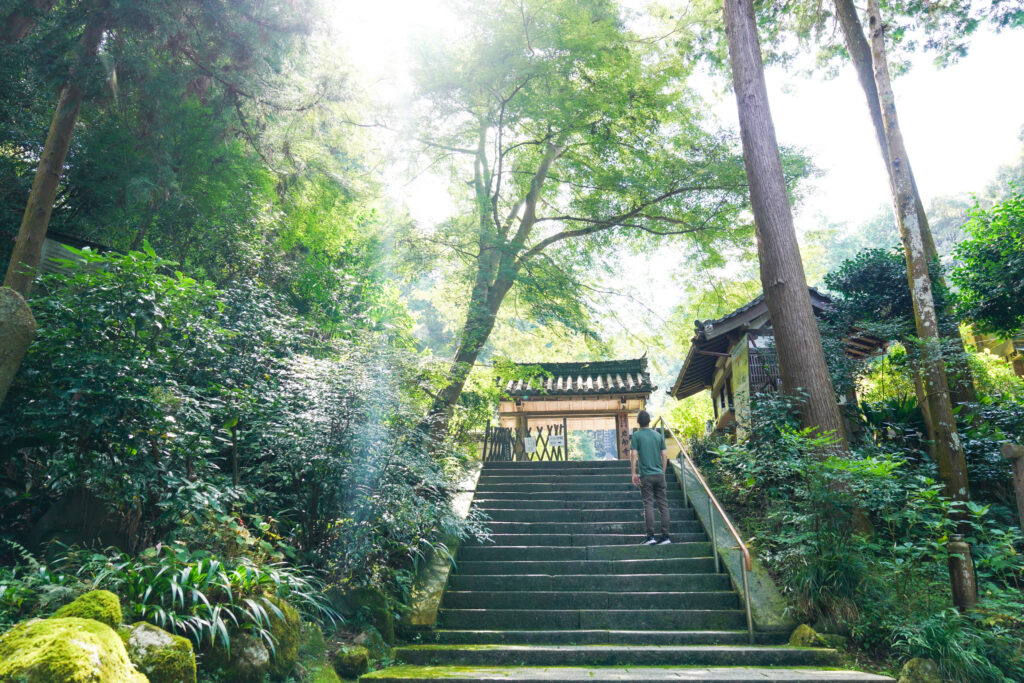
Begin your journey at JR Kamo Station, accessible for free with the Japan Rail Pass. A short bus ride into the mountains will take you to Gansenji Temple in the Tono area. It’s a small yet significant temple founded in 729. Tono is where devout priests and monks from Heijō-kyō (the ancient capital of Nara) sought refuge and settled to dedicate themselves to spiritual training. Once you’re there, the reason why they chose this location will become clear.
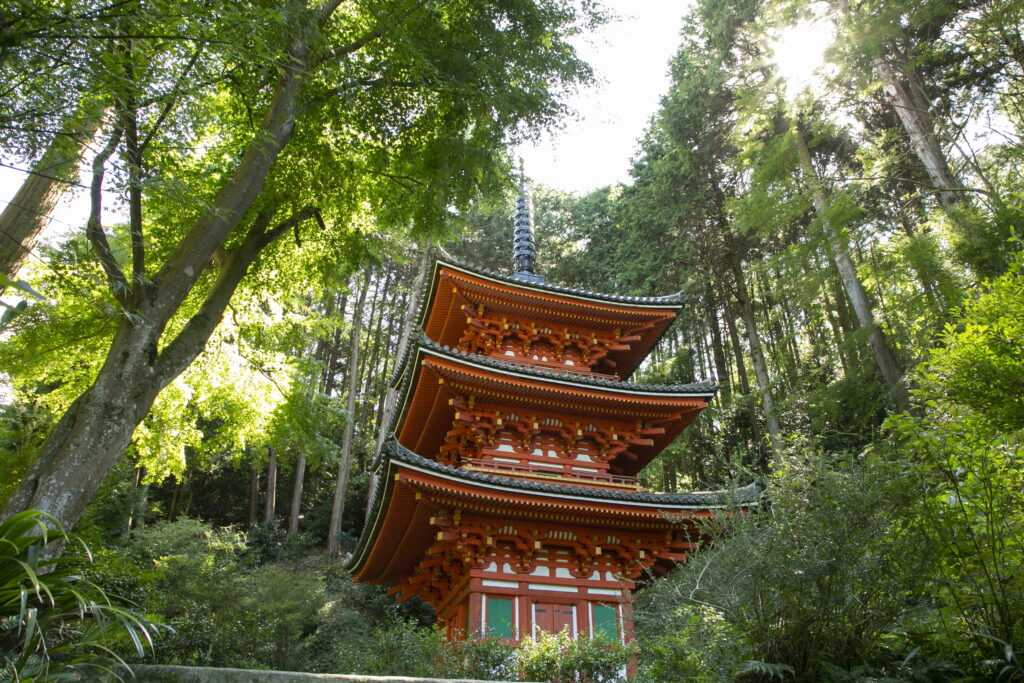
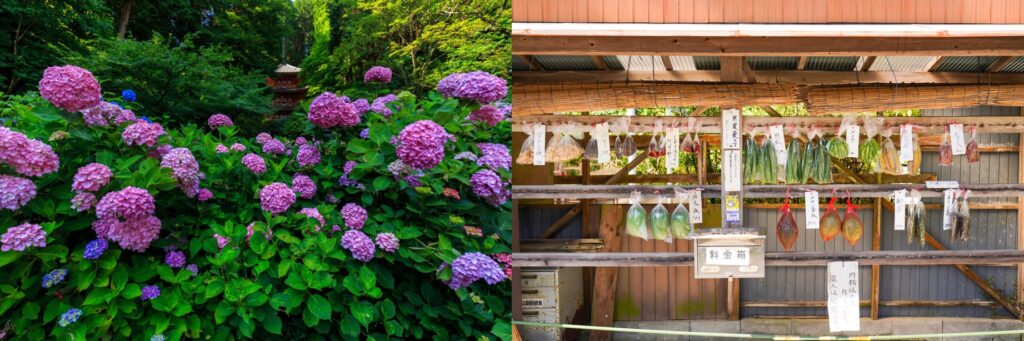
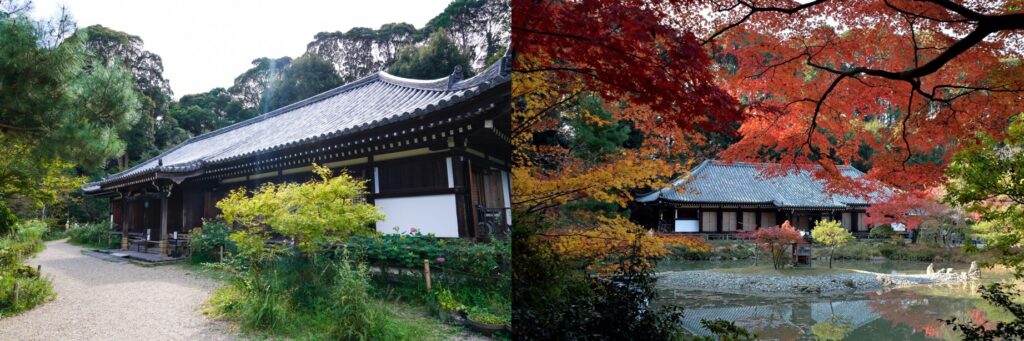
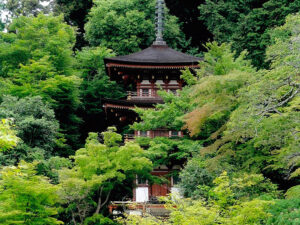
Known as one of Kyoto’s Hana no Tera (the flower temples), Gansenji Temple provides a wonderful sense of harmony with nature. Around June, you can enjoy a beautiful display of about five thousand hydrangea bushes with fascinating colors. Also, the fall foliage is amazing with the awe-inspiring Three-storied Pagoda. The temple is adorned by a variety of other flowers as well, and is truly a sight to see in any of the four seasons.
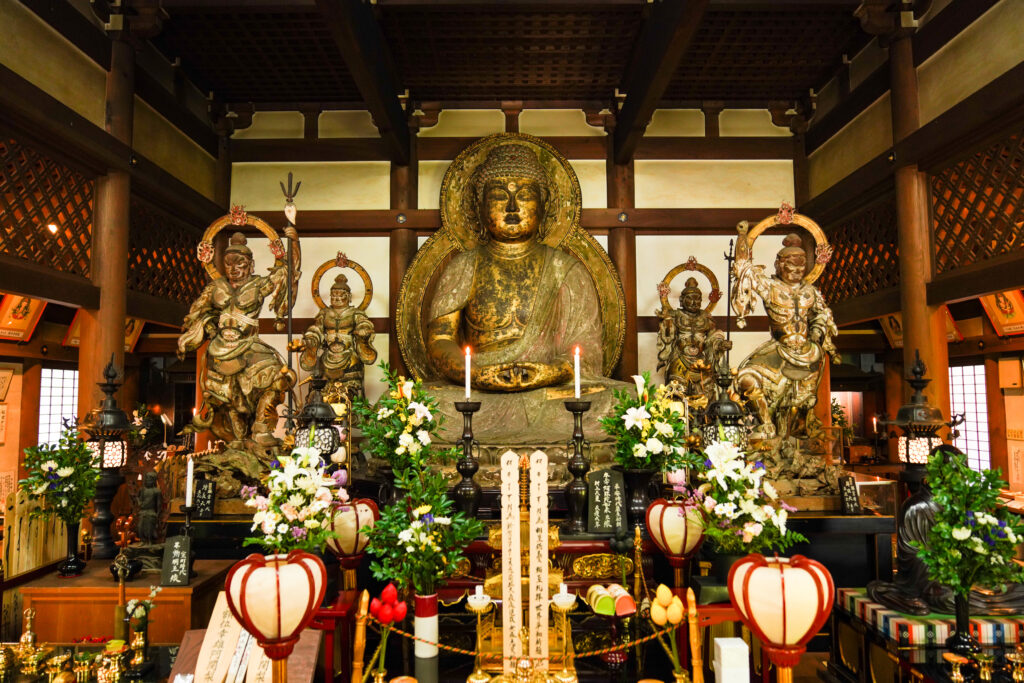
Gansenji Temple thrived in history, and today it offers a tranquil experience. While it’s a remarkable site, you might not encounter foreign tourists. In the main hall, you can see Amida Nyorai, the Buddha who has been believed to come to people when they pass away, and revered deeply by numerous people since ancient times. Gansenji Temple’s wooden statue of Seated Amida Nyorai is about three meters tall, and the gentle, sublime expression brings comfort to viewers. You’ll be overwhelmed as you imagine the original appearance from the whole statue’s golden glow and the faint vermilion paint remaining on the clothes even after a thousand years. The serene aura of the enlightened Amida Nyorai is really captivating.
The statues of Four Heavenly Kings around the Amida Nyorai are in good condition, which also allows you to imagine the original colors on the ancient carved wood. Those statues are encircled by smaller treasures of the temple, offering a rare opportunity to get close to the precious exhibits and appreciate them in detail. You can also see the statue of Fugen (Samantabhadra) Bodhisattva riding a white elephant, which was restored in December 2024 for the first time in 113 years.
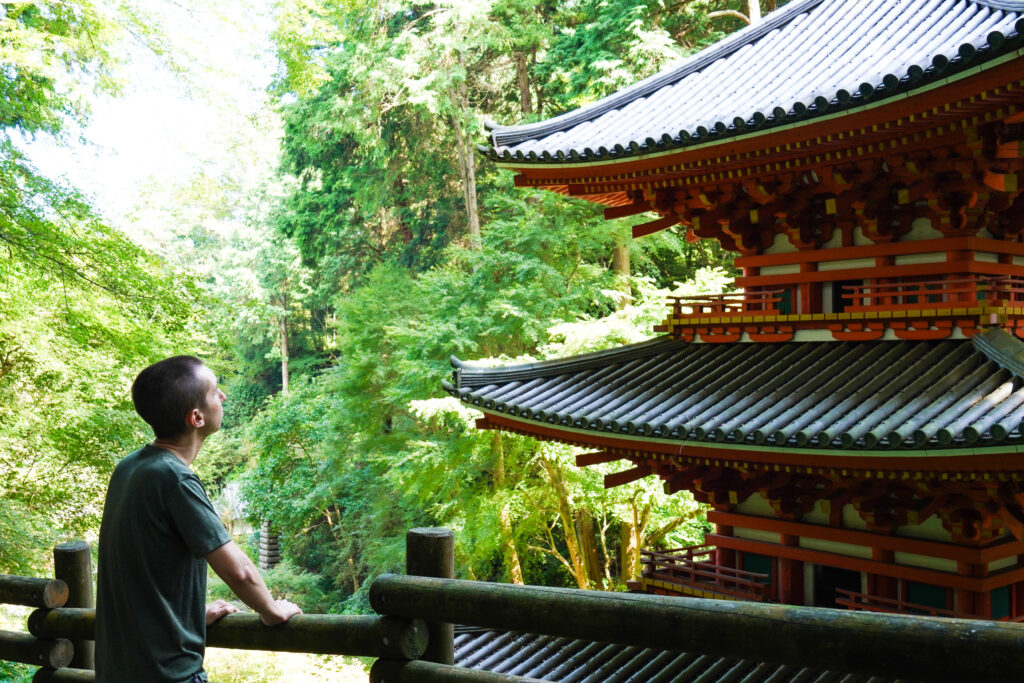
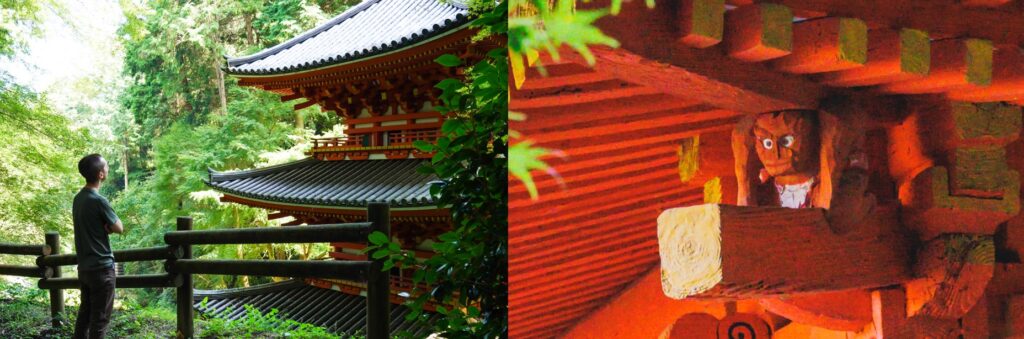
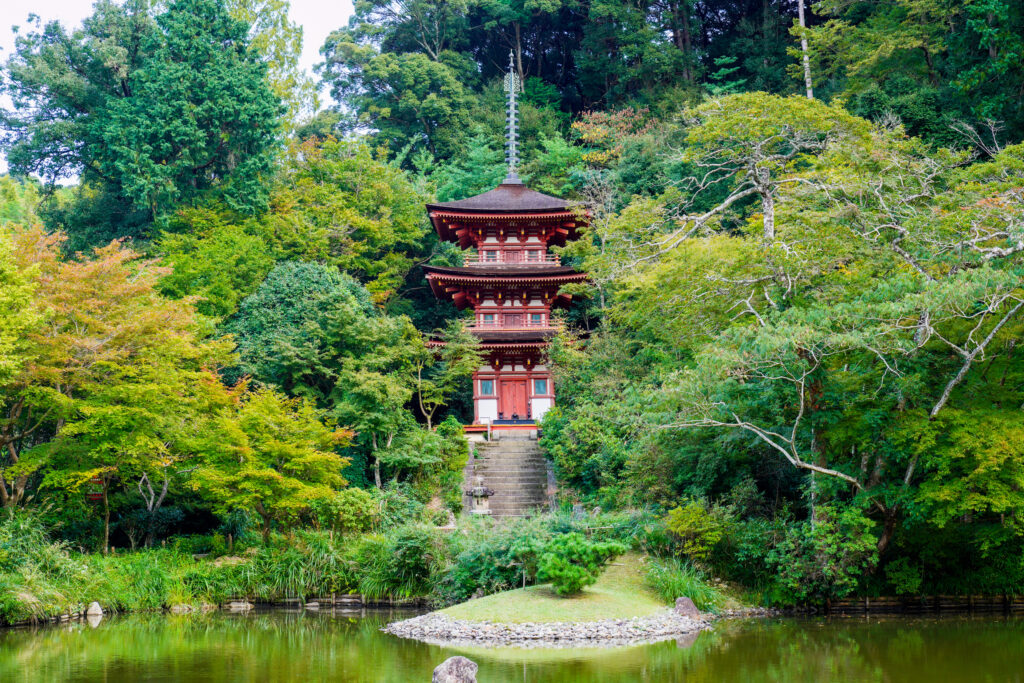
Beyond the main hall, a small pond sits serenely, with the vibrant pagoda rising majestically beyond it. The pagoda appears larger and farther away than it actually is. A closer look at the design reveals its secret: the structure subtly tapers towards the top, creating the illusion.
What’s unusual is that there’s a path that spirals up around the pagoda. As you ascend, you’ll feel as if you were floating up around the pagoda that leads you towards heaven. And you can see small wooden figures called sumioni (corner demons), which are said to ward off evil spirits, at each corner of each level of the pagoda. They seem to hold up the rafters, which is very interesting. Different sumioni have different expressions, and they are one of the unique symbols of this temple.
After visiting the temple, soak up the local atmosphere. As soon as you exit the temple, you might come across stalls with rows of hanging vegetables from nearby farms. These small stands are a charming feature of this area, so consider leaving some coins and grabbing some seasonal vegetables, pickles or other treats as a gift for yourself or your family.
Gansenji Temple
Gansenji Temple is an ancient Buddhist temple in Kamo-cho, Kizugawa City, the southernmost part of Kyoto Prefecture. It’s located in the tea-producing region of Kyoto. The temple was founded in 729. T …
Sekibutsunomichi (Stone Buddha Road), Full of Wonder
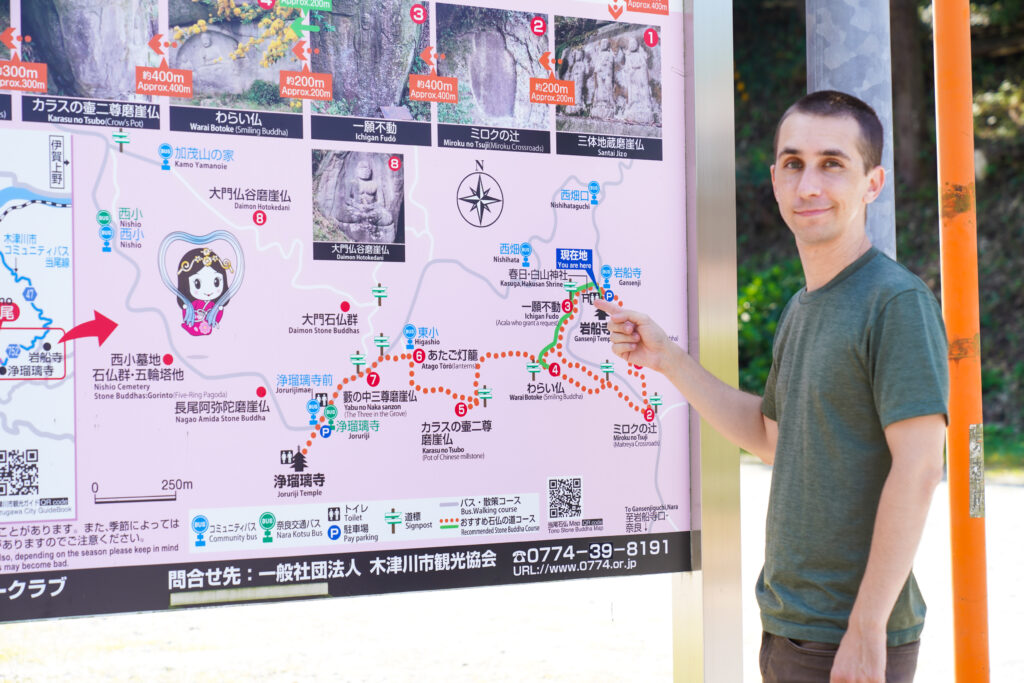
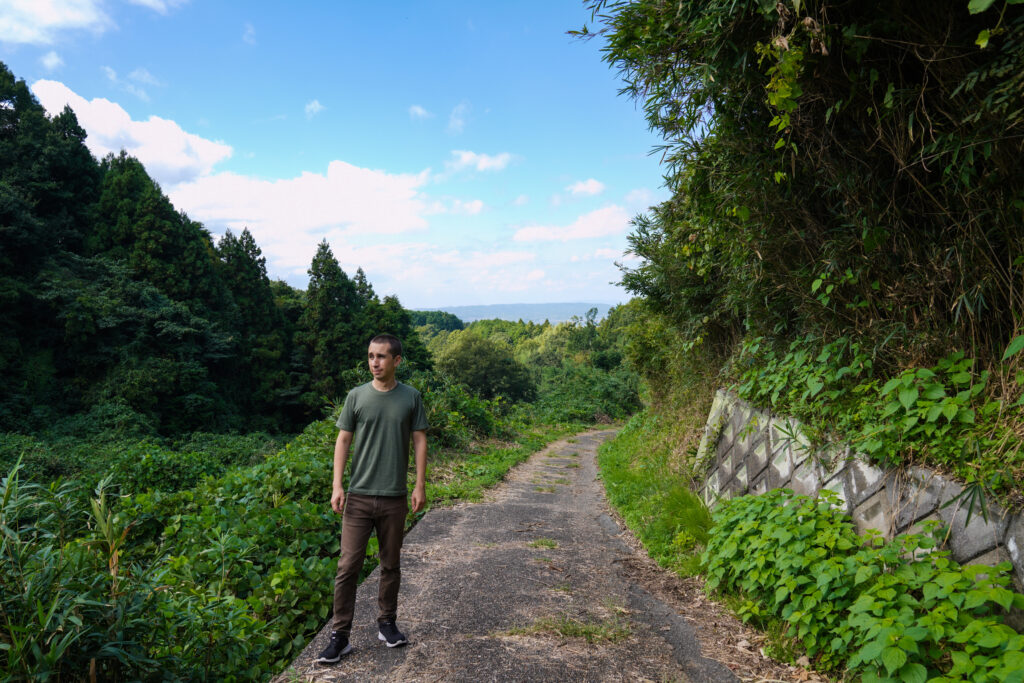
Upon leaving Gansenji Temple, your wonderful hike begins. There is a board of the trail map near the temple, and there will be signs to guide you on your journey. The mountain trails to Joruriji Temple are mostly gentle downward slopes, with two routes available: one takes about 40 minutes (2 km), and the other takes about 50 minutes (2.4 km). Along the way, discover Buddhist carvings on the rocks, which are the footprints of ancient people.
Descending, enveloped in greenery, the route winds past rice paddies and vegetable fields. It’s sometimes unpaved and at times runs along a whispering stream. These nostalgic paths conjure up images of ancient times. It’s fun to imagine people from various eras such as samurai, monks and peasants walking around here likewise.
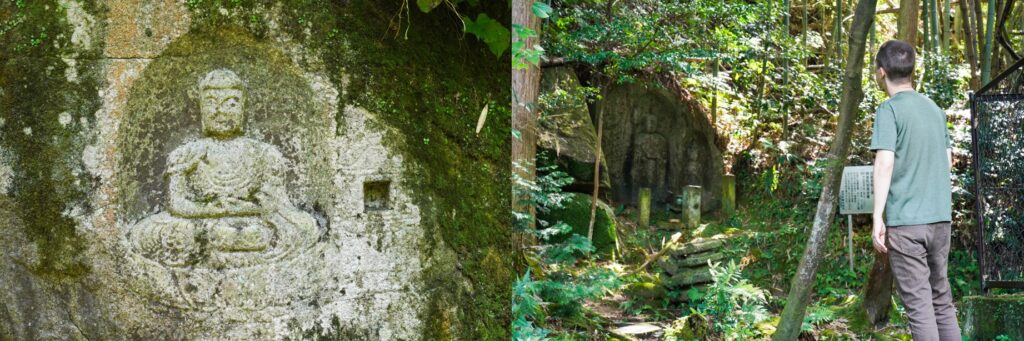
Tono, where many priests and monks resided for spiritual training, saw the creation of a lot of Buddhist structures and the carving of rock Buddhist images that have served as guides for travelers on the paths. These artworks will remind you of the Buddhist history of Tono. Some of them have inscriptions indicating that they were carved by stonemasons at the request of the priests from the temples. As you enjoy your hike, you might start to think that this whole area is like one massive museum. (In addition, there are many more stone Buddhas beyond this route.)
You can find the routes on the map below. The first encounter will be Ichigan Fudo (Acala) who grants only one wish (MAP1), or Santaijizo (Three Kshitigarbha) representing the past, present, and future (MAP2).
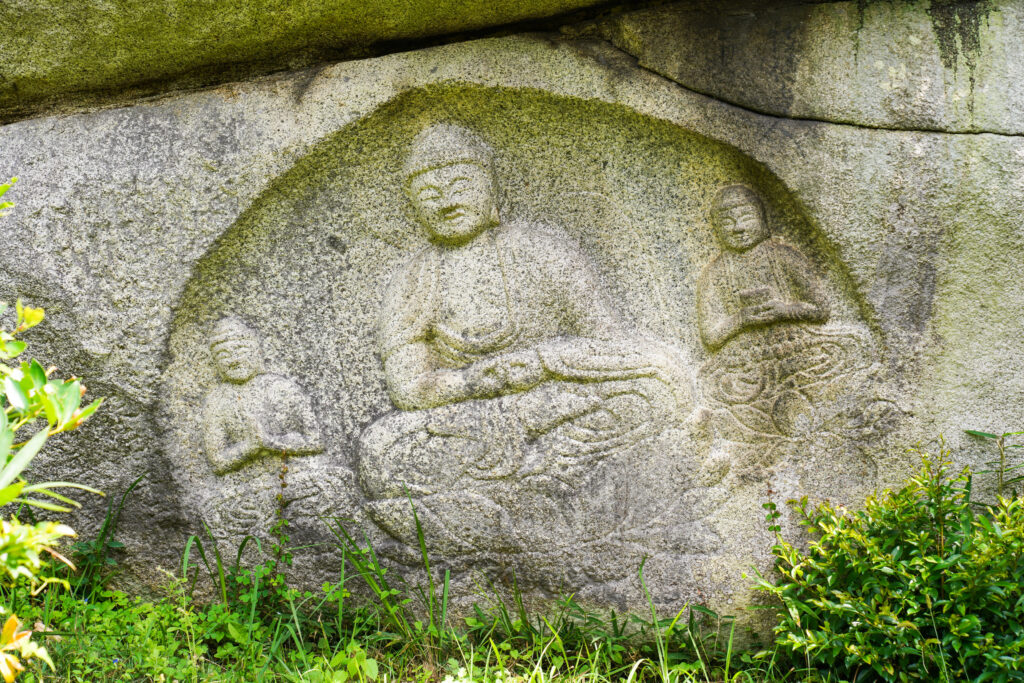
A few minutes further down the path is Warai Botoke (Smiling Buddha), one of the most popular on the trails (MAP3). It was carved in the 13th century, and remains in a good condition thanks to the overhanging rock forming a natural shelter. The inscription on the rock tells us that Gansenji Temple commissioned a stonemason to create it.
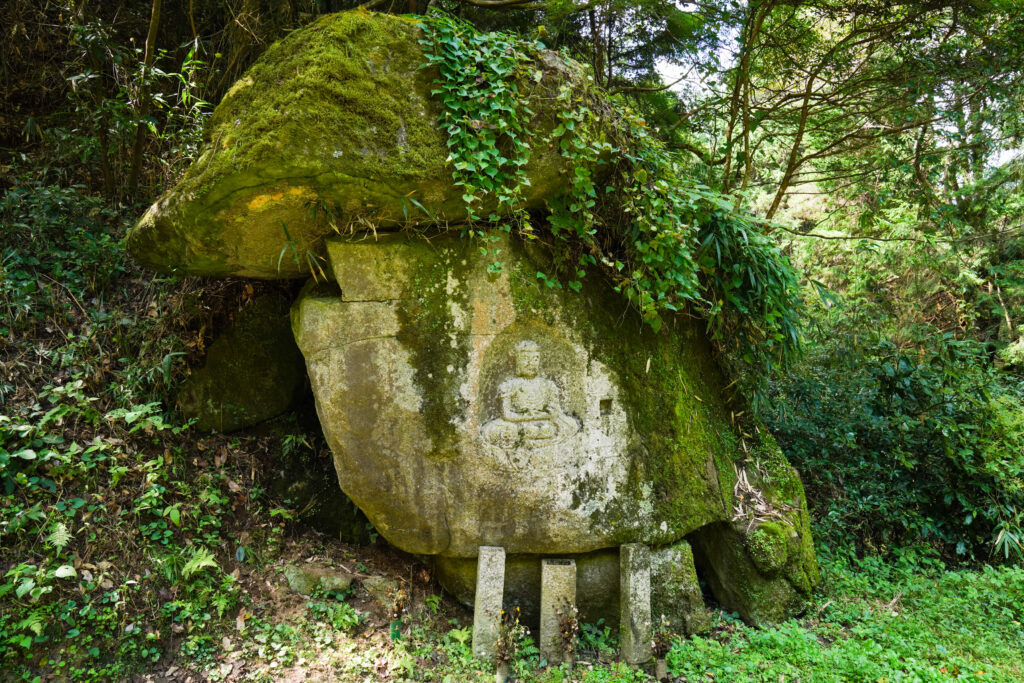
Next, two buddhas carved in the 14th century await at the fork where the paths intersect (MAP4). The place is called Karasu no Tsubo. Right next to the smiling Amida Nyorai, there is a stone lantern with a deep hollow, where tomyo (a votive light) is offered. (In Buddhism, offering a light to a sacred object is believed to be a meritorious act, enlightening ignorance with the light of wisdom.) There is a carving of Jizo Bosatsu (Kshitigarbha) on the left side of the rock, offering a three-dimensional charm.
Then, you’ll see another lantern, Atago Tōrō, and the final encounter is “Yabu no Naka sanzon” (MAP5). Under a leafy canopy just off the road, you’ll find three stone Buddhist images. Created in 1262, they are the oldest among Tono’s stone Buddhas bearing inscriptions. These Buddhas, with their gentle expressions, must have brought comfort to people from poor peasants to noble priests.
Joruriji Temple, Where Your Heart Might Be Reborn
The hike through Tono’s mountain paths can be considered a sort of mini pilgrimage, and a spectacular reward awaits at the final destination. Here stands Joruriji Temple, a Buddhist sanctuary that offers a glimpse into Gokuraku Jodo (the Pure Land in Buddhism) that awaits devout followers in the next world.
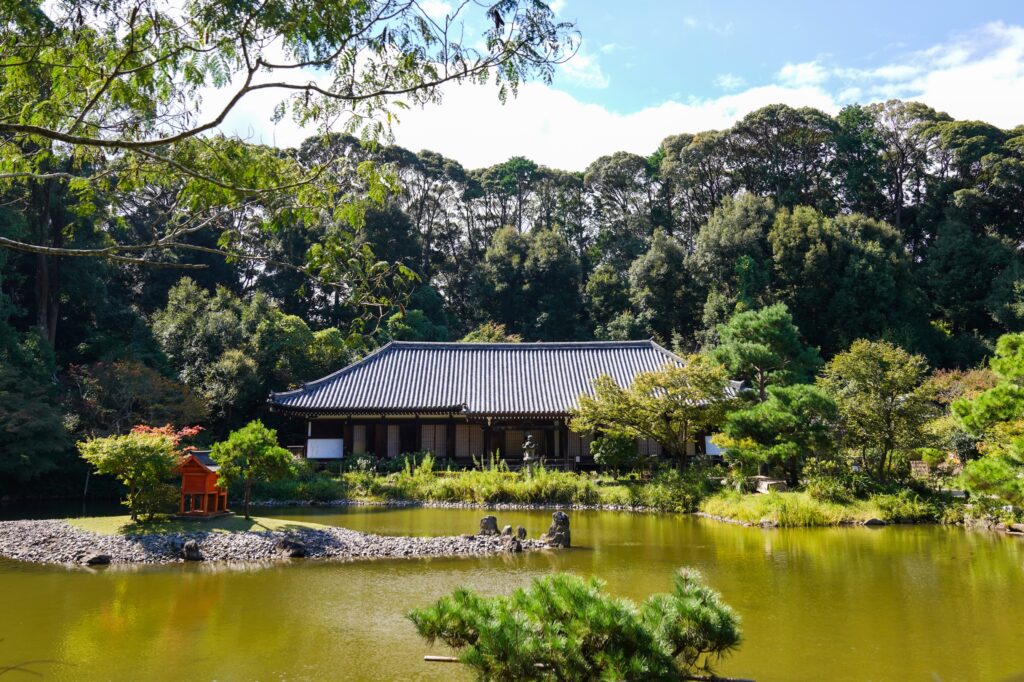
Like Gansenji Temple, Joruriji Temple is a hidden gem worth discovering, enveloped in a serene and peaceful atmosphere. The Three-Storied Pagoda stands in the east, where the sun rises, while the Main Hall is situated in the west, where the sun sets. The pond between them represents the ocean between this world and the next, and symbolizes Gokuraku Jodo. A path encircles the pond, allowing visitors to stroll while enjoying the scenery. The wooden Three-Storied Pagoda was transferred to this temple in 1178, and houses a statue of Yakushi Nyorai (the Medicine Buddha), who is believed to save all beings from suffering from illness. This statue is generally not open to the public, but can be viewed on the 8th of every month and on the vernal and autumnal equinox days, if the weather is good.
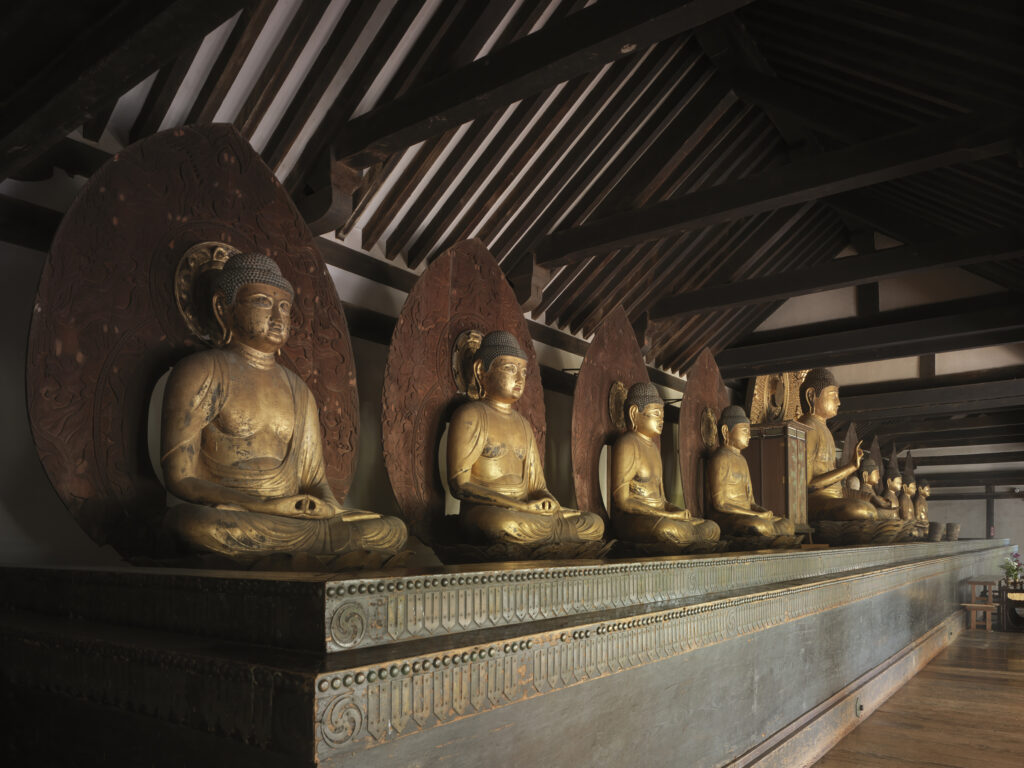
The Main Hall houses nine statues of Amida Nyorai. Actually, Joruriji Temple is the only temple remaining with both nine Amida Nyorai statues and their hall. Furthermore, it is valuable to preserve the layout of Amida Nyorai in the west, Yakushi Nyorai in the east, and a pond in the center.
Experiencing this tranquil scenery here is an excellent way to understand the connection between garden landscape designs found in Japanese temples and Buddhist doctrine.
In the Main Hall, the nine Amida Nyorai statues are lined up in a long row, which is quite splendid. In Japan, Amida Nyorai has been believed to lead people to Gokuraku Jodo when they pass away. In the 12th century, many halls were constructed around Kyoto, each housing nine Amida Nyorai statues like this. Each statue represents each of nine manifestations of Amida Nyorai, in correspondence with each of the nine patterns of rebirth.
These magnificent beings, bathed in divine light, came from Gokuraku Jodo. We are fortunate to experience their full impact at very close range. Before appreciating them, don’t forget to visit the Three-Storied Pagoda enshrining the Yakushi Nyorai and pray to it, then turn around and offer a prayer to the Amida Nyorai across the pond. Stepping out of the dim Main Hall feels a bit like being reborn into the human world. A simple stroll through the small garden is like experiencing the entirety of life and death. Whether you’re Buddhist or not, there will be something here that resonates with your soul.
Through the experience of “ascending to heaven” at Gansenji Temple, a unique hike on Sekibutsunomichi, and the profound sense of wonder at Joruriji Temple, one of the things you’ll feel might be that this world can be a paradise if we think it is so.
*Please note that the Amida statues are being removed and repaired in pairs until the end of 2023.
Joruriji Temple
Joruriji Temple, located in the southern part of the Kyoto Tea Country region, is a temple of the Shingon Risshu sect of Buddhism. Though the early history of the temple is shrouded in mystery, histor …
JR Kamo Station can be reached from Kyoto Station via rapid train. It takes about an hour, with a single transfer at JR Kizu Station. You can use the Japan Rail Pass.
From JR Nara Station, it takes about 15 minutes to JR Kamo Station by rapid train. This is also covered by the Japan Rail Pass.
Gansenji Temple is accessible by Kizugawa City Community Bus from the east exit of JR Kamo Station. The buses run once an hour, departing at 44 minutes past each hour between 8:44am and 3:44pm (about a 15-minute ride).
To return to JR Kamo Station from Joruriji Temple, the buses also run hourly, departing at 14 minutes past the hour between 9:14am and 4:14pm (about a 20-minute ride).
(The above transportation information is current as of January 2025 and is subject to change.)
Tono Map *The names in parentheses are those used on the map below.
Gansenji Temple
1. Ichigan Fudo(Fudo Myou)
2. Santaijizo(The Trio of Jizo Bosatsu)
Miroku no Tsuji(Miroku Bosatsu)
3. Warai Botoke
4. Karasu no Tsubo
Atago Tōrō (Atago Stone Lantern)
5. Yabu no Naka sanzon(The Trio in the Grove)
Joruriji Temple