Term archive
投稿タイプ:sightseeing
Ikkyuji Temple
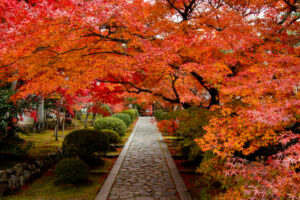
In ancient times, there was a Zen training monastery here, but it was destroyed in a war. In the Muromachi Period (1336-1573), the Buddhist priest and Zen master Ikkyu Sojun restored it. He is widely known in Japan for his wit and wisdom, and is the subject of various fun stories.
The temple is also known for its beautiful Shuon’an Rock Gardens that are designated as a Place of Scenic Beauty. It includes the Hojo Garden that consists of the north, east, and south gardens. Each garden has its own distinctive features and is a superb example of karesansui (traditional Japanese Zen rock garden). Also, the temple houses 9 Important Cultural Properties such as the main hall, the abbot’s hall and the seated Ikkyu Osho statue.
At the temple, visitors can enjoy traditional Shojin Ryori (Buddhist Vegetarian Cuisine), as Japanese Buddhist monks have had for centuries. There are options from tenshin (a light meal) to Makunouchi (a popular type of Japanese boxed meals) and Honzen (a classic multi-course meal). This temple’s signature, fermented soybeans called Ikkyuji Natto, is interesting, too. It is popular for its rich, unique flavor, and many visitors purchase it to bring home. Traditionally, making Ikkyuji Natto is one of the tasks for the temple’s incumbent chief priest.

投稿タイプ:sightseeing
Shoho-ji Temple (Wazuka Town)
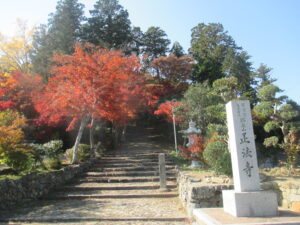
It is said that a Buddhist monk Gyoki established Shoho-ji Temple to pray for the repose of Prince Asaka, one of Emperor Shomu's sons, in the Nara Period (710-794). The temple was devastated by war at the end of Kamakura Period (1185-1333), and moved to its present location in the Edo Period (around 1603-1868).
In the fall, you can see the temple precincts adorned with brilliant ginkgo and Japanese maple trees. The approach is amazing with vibrant fall colors as well. Furthermore, the temple's architecture adds the unique atmosphere to the beautiful place. You can also enjoy a wonderful view of tea fields, a reminder that Wazuka is a fascinating place called Chagenkyo (Teatopia).
投稿タイプ:sightseeing
Kaijusenji Temple
Legend has it that Fujioyama Kannonji Temple was founded in 735 when Emperor Shomu ordered the Buddhist monk Roben to build a hall and enshrined the Eleven-Headed Kannon Bodhisattva to pray for the safe construction of the Great Buddha statue of Todai-ji Temple.
Unfortunately, the temple was burnt down in 1137. In 1208, Jokei, a monk of Kasagidera Temple, moved to the ruins, and built a hermitage for Buddhist practice. The place was renamed Fudarakusan Kaijusenji Temple and revived.
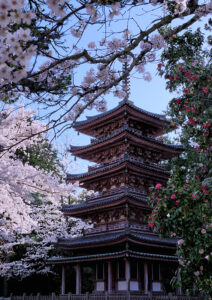
The five-storied pagoda is designated as a National Treasure. The vermilion pagoda, standing 17.7 meters tall, is a precious relic completed in 1214. The temple houses many other treasures. For example, there are many Important Cultural Properties, including the principal image of the Standing Eleven-Headed Kannon Bodhisattva, the Monjudo hall, a Mandala (a sacred geometric design) of the Lotus Sutra painted in color on silk, and documents about the temple.
The temple precincts offer much more to see. The eggplant-shaped bench is believed to fulfill wishes when sitting on it. You can also see a huge Yamamomo (Japanese Bayberry) tree that is one of the “200 Selected Nature Sites of Kyoto.”
Moreover, nestled in the mountains at a height of approximately 200 meters, the temple offers a great view of the Mikanohara area, where the “phantom capital” of Kunikyo was located. On a clear day, you can even see the ruins of Heijo Palace in Nara. The scenery is even more beautiful when viewed with the fall foliage. The temple is also amazing in spring, with cherry blossoms in bloom.
投稿タイプ:sightseeing
“The Tale Of Genji Museum, UJI”
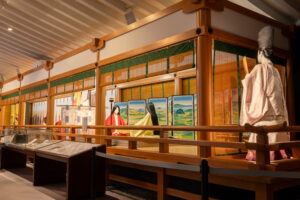
The Tale of Genji is a worldwide-known masterpiece of classical Japanese literature written by Murasaki Shikibu in the Heian Period (794-1185). It depicts the romantic entanglements of a fictional character Hikaru Genji, an extraordinarily handsome nobleman. The final 10 chapters of the tale, after his death, are set in Uji. At this museum, there is a touchscreen display with comprehensive English explanations, a fun interactive game in English, and various other attractions, such as colorful exhibits and animated movies, allowing you to experience the glamorous world of The Tale of Genji. The museum offers fascinating glimpses into various aspects of Japanese culture in the Heian Period, including fashion, architecture, and vehicles.
投稿タイプ:sightseeing
Cherry Blossoms Along Maekawa Dike
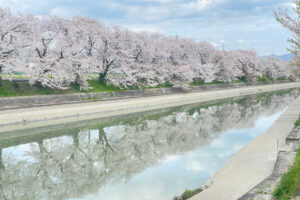
Maekawa Dike in Higashi-Imoarai is a beloved destination for hanami (cherry-blossom viewing), drawing crowds of all ages each spring. As one of the “200 Selected Nature Sites of Kyoto,” the beautiful promenades offer a quintessential Japanese spring scene. Mainly somei-yoshino (the most popular variety of sakura) trees line both banks of the river. When the petals fall, they float on the water, creating a picturesque sight. The reflection of the blossoms in the river adds to the enchanting ambiance. In the evening, the trees are illuminated, which creates a magical spectacle.
After immersing yourself in the beauty of the spring, consider visiting The Original Yamada Residence nearby. Its imposing appearance reminiscent of a Buke-Yashiki (samurai house) is amazing. Also, you can rent an electric bike at Machinoeki Crosspeer Kumiyama, and enjoy cycling. It only takes about 10 minutes to arrive at Maekawa Dike. After viewing the cherry blossoms, you can explore the town at your own pace.
As a side note, "Higashi-imoarai (東一口)" is an interesting name that many Japanese people struggle to read its simple kanji (Chinese characters).
投稿タイプ:sightseeing
Jinnoji Temple
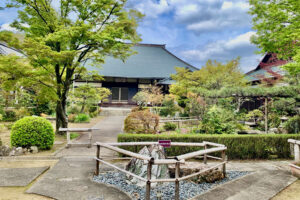
This temple was established by the monk Gyokyo, in 860. The main hall enshrines a statue of Yakushi Nyorai (the Medicine Buddha). The Gyokyo statue (an Important Cultural Property) originally was enshrined in the Iwashimizu Hachimangu shrine when it was still a shrine-temple complex. The statue was removed from there when the government ordered the separation of Shinto and Buddhist religious practice in 1868, and it was transferred to the main hall of Jinnoji Temple in 1873.
Also, this temple offers a brilliant display of fall foliage along the approach and in the precincts. A majestic ginkgo tree graces the temple precincts as well.
Please note that advance reservations are required to view the interior of the main hall.
投稿タイプ:sightseeing
Gansenji Temple
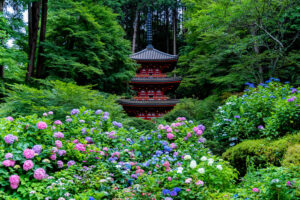
Gansenji Temple is an ancient Buddhist temple in Kamo-cho, Kizugawa City, the southernmost part of Kyoto Prefecture. It’s located in the tea-producing region of Kyoto. The temple was founded in 729. The name "Gansenji" translates literally to "Rock Boat Temple," and near the entrance of the temple is a boat-shaped rock, where legend has it that monks used it for sacred cleansing rituals. In the temple precincts, the Three-storied Pagoda, the Important Cultural Property, stands surrounded by nature. It looks dignified and mystic, and its wooden demon carvings are very interesting. The temple is famous for its hydrangeas that are beautiful around June. After the hydrangeas, water lilies and crape myrtle blossoms follow, and fall foliage is impressive as well. In the cold season, you can see vivid camellia flowers and pretty plum blossoms, and in the spring, cherry blossoms are amazing. The temple is also adorned by a variety of other flowers, and is truly a sight to see in any of the four seasons. Gansenji Temple’s wooden statue of Seated Amida Nyorai is about three meters tall, and the gentle, sublime expression brings comfort to viewers. You’ll be overwhelmed as you imagine the original appearance from the whole statue’s golden glow and the faint vermilion paint remaining on the clothes even after a thousand years. The serene aura of the enlightened Amida Nyorai is captivating, and there is another awesome statue, Fugen (Samantabhadra) Bodhisattva riding a white elephant. This statue was restored in December 2024 for the first time in 113 years. As a side note, paths connecting Gansenji Temple and Joruriji Temple called Sekibutsu no Michi (paths with stone Buddhas) are a great place for hiking through history where you can meet many stone Buddhas.
投稿タイプ:sightseeing
Mimurotoji
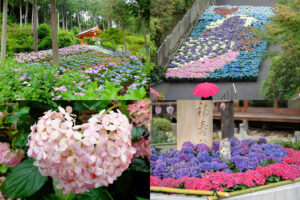
The Mimurotoji temple is located in Uji City in the Kyoto Tea Country region, southern Kyoto Prefecture. This temple has a long history, and its Treasure House enshrines Buddhist statues including Important Cultural Properties. It is also known for its magnificent gardens. Referred to as Hana no Tera (the flower temple), it is among the most renowned flower spots in the Kansai region. Strolling the garden paths during the blooming seasons allows visitors to be surrounded by a profusion of flowers. Around late February to March, weeping plums bloom on an elevated area, offering a lovely view together with the landscape of the city. Around April, 10,000 azaleas, including red ones, come into bloom. Additionally, around late April to early May, the other azalea garden showcases approximately 20,000 flowers in white and pink hues. Around June, about 20,000 hydrangea plants of various colors, such as blue, purple, pink, and white, can be enjoyed. Around late June to early August, lotus flowers (which bloom in the morning) can be seen in front of the main hall. Their gradation of colors, primarily white and pink, is very beautiful. The temple offers various other flowers and autumn foliage. Also, there is a pond and a dry rock garden where you can feel the beauty of Japan. Depending on the season, there may be a teahouse in the precincts. It would be nice to take a break there while enjoying the beautiful flowers.
投稿タイプ:sightseeing
Shoujuin
Shoujuin, a Buddhist temple of the Koyasan Shingon sect, is located in Ujitawara Town in southern Kyoto. It was founded in 1200, more than 800 years ago. Two fires between the 15th and 19th centuries limited the records of this temple, but it is known that a monk Yuin revived it in 1596.
The temple's principal image, the eleven-headed Kanzeon (Avalokiteśvara) Bodhisattva statue, is designated as a cultural property of Ujitawara Town. The statue is unveiled only once every 50 years. (It is being held as of April 2025!) There is also a seated statue of Fudo Myo-o (Acala), one of the Buddhist Wisdom Kings. It is the work of Kaikei, one of the representative Buddhist statue sculptors of the Kamakura Period (1185-1333) in Japan. This statue is an Important Cultural Property of Japan.
The temple holds its annual festival featuring fūrin (wind chimes) from June 1st to September 30th. Over 2,000 wind chimes create a cool and pleasant atmosphere with the visual and auditory beauty.
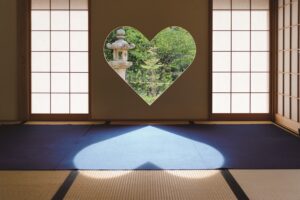
In the guest hall, there is Inome-mado (boar’s eye window), which is always attracting many visitors. The Inome (boar’s eye), a heart-shaped motif, is a traditional design that has been used since approximately 1400 years ago, primarily for architectural adornment in shrines and temples. The Inome has been believed to ward off evil spirits and bring good fortune. Shoujuin’s Inome-mado offers beautiful sights of the garden that transform with the seasons: pink cherry blossoms in spring, lush greenery in summer, colored leaves in fall, and a white snowscape in winter. Moreover, if the season and time are just right, you might encounter a miraculous moment when the sunlight streams through the window, creating another heart shape in the shadow. This sight is called Shiawase no Okage, which means a blessing of happiness. (Awase means something put together, and kage means shadow in Japanese.)
Also, the 160 different paintings on the ceiling of the guest hall are eye-catching. These artworks mainly depict seasonal flowers, plants and landscapes of Japan. Among them, you can find beautiful maiko (young female apprentices learning various traditional Japanese performing arts), too.
In addition, this temple offers great experiences, such as juzu (a bracelet of prayer beads) creating, shakyo (sutra copying), shabutsu (Buddha copying), and yoga. (Reservations required.)
投稿タイプ:sightseeing
Hiko-jinja Shrine
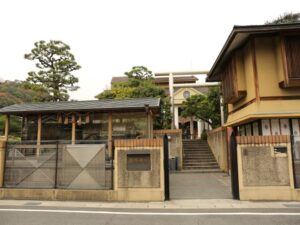
Hiko-jinja Shrine, located in Yawata City, was founded in 1915 by a pioneer of aviation, Chuhachi Ninomiya. He achieved Japan’s first successful flight of a rubber-powered, crow-type model aircraft. “Hiko” of “Hiko-jinja Shrine” means “flight” in Japanese.
The shrine is dedicated to Nigihayahi-no-Mikoto, known as an ancient deity of the sky, victims of aviation accidents, great people who made significant contributions to the aviation industry, and more. For this reason, various people from home and abroad visit it to pray for safety in flight, successful development and invention, academic successes and passing exams, or other related blessings.
Hiko-jinja Shrine looks very different from other traditional shrines, with its architectural style reminiscent of ancient Greek buildings, and metal torii (a gate most commonly found at a Shinto shrine in Japan). You can also find a great metal propeller on display, and a cluster of small airplanes floating in a washbasin that visitors use to wash and purify their hands.
As the shrine was built on the site of Chuhachi Ninomiya's residence, a wealth of materials related to his researches and experiments are preserved here. They are displayed with donated things by various people. (A fee is required for admission to the museum.)
投稿タイプ:sightseeing
Juhoji Temple
Juhoji Temple, located in Kyotanabe City, is thought to have been established in 704.
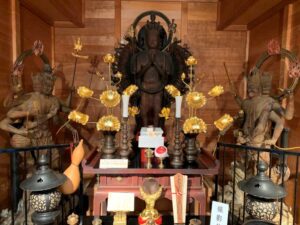
The main hall enshrines the standing statue of the temple's principal deity, the Thousand-Armed Kannon. It is a 180 cm tall wooden statue, a masterpiece designated as an Important Cultural Property. Along with the statues of Fujii-dera Temple in Osaka and Toshodaiji Temple in Nara, this statue is one of the three Thousand-Armed Kannon statues in Japan that actually have one thousand hands. On each of its hands is a charcoal drawn eye, most of which have faded with time, but some still remain. Another unique feature of the statue is how the face expressions change with the light. In the brightness of daytime, it appears solemn and dignified, while bathed in the soft lighting, such as that seen at dusk, it seems much softer and gentler. It has a mysterious fascination that captivates viewers.
Advance reservations are required to see the Thousand-Armed Kannon statue (phone: 0774-65-3422). Please provide the date of your visit and number of visitors. (Viewing is unavailable on rainy or humid days as a general rule.) You can hear explanations of the statue, so consider bringing a translation device or going with someone who understands Japanese to fully enjoy your visit.
投稿タイプ:sightseeing
Hanayagi Strawberry Farm
This fun place opened in 2003 in Seika Town, southern Kyoto Prefecture. They offer strawberry picking and edamame (young soybean) harvesting.
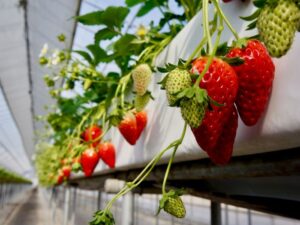
From winter to around spring, you can pick and enjoy the flavor of your own strawberries, freshly picked, sweet and juicy. (The exact timing varies from year to year.) You can eat as many strawberries as you like for 40 minutes. The main variety is the popular Akihime, with occasional Benihoppe. The bright red strawberries grow in abundance, which is a feast for the eye, too. They use raised beds, and there is no need to bend over low, and the aisles are wide. It’s a comfortable place offering an exciting experience for anyone, including people with strollers and wheelchairs. Furthermore, their greenhouses can accommodate large groups. Even groups of 200-300 people have enjoyed it. Groups can come by bus, too. In addition, the farm offers products using their strawberries, as well as freshly packed strawberries.
The edamame harvesting is held in October. You can harvest high-quality black soybeans Shin-tamba-guro, one of the local specialties of the Tamba region in Kyoto. They are also available for purchase at the farm's direct sales store. Both strawberry and edamame harvesting require advance reservations by phone or through their website.