Term archive
投稿タイプ:sightseeing
Juhoji Temple
Juhoji Temple, located in Kyotanabe City, is thought to have been established in 704.
The main hall enshrines the standing statue of the temple's principal deity, the Thousand-Armed Kannon. It is a 180 cm tall wooden statue, a masterpiece designated as an Important Cultural Property. Along with the statues of Fujii-dera Temple in Osaka and Toshodaiji Temple in Nara, this statue is one of the three Thousand-Armed Kannon statues in Japan that actually have one thousand hands. On each of its hands is a charcoal drawn eye, most of which have faded with time, but some still remain. Another unique feature of the statue is how the face expressions change with the light. In the brightness of daytime, it appears solemn and dignified, while bathed in the soft lighting, such as that seen at dusk, it seems much softer and gentler. It has a mysterious fascination that captivates viewers.
Advance reservations are required to see the Thousand-Armed Kannon statue (phone: 0774-65-3422). Please provide the date of your visit and number of visitors. (Viewing is unavailable on rainy or humid days as a general rule.) You can hear explanations of the statue, so consider bringing a translation device or going with someone who understands Japanese to fully enjoy your visit.
投稿タイプ:sightseeing
Hanayagi Strawberry Farm
This fun place opened in 2003 in Seika Town, southern Kyoto Prefecture. They offer strawberry picking and edamame (young soybean) harvesting.
From winter to around spring, you can pick and enjoy the flavor of your own strawberries, freshly picked, sweet and juicy. (The exact timing varies from year to year.) You can eat as many strawberries as you like for 40 minutes. The main variety is the popular Akihime, with occasional Benihoppe. The bright red strawberries grow in abundance, which is a feast for the eye, too. They use raised beds, and there is no need to bend over low, and the aisles are wide. It’s a comfortable place offering an exciting experience for anyone, including people with strollers and wheelchairs. Furthermore, their greenhouses can accommodate large groups. Even groups of 200-300 people have enjoyed it. Groups can come by bus, too. In addition, the farm offers products using their strawberries, as well as freshly packed strawberries.
The edamame harvesting is held in October. You can harvest high-quality black soybeans Shin-tamba-guro, one of the local specialties of the Tamba region in Kyoto. They are also available for purchase at the farm's direct sales store. Both strawberry and edamame harvesting require advance reservations by phone or through their website.
投稿タイプ:sightseeing
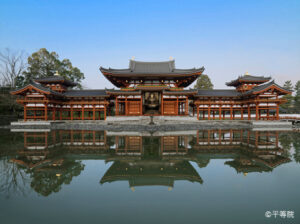
Byodoin Temple
Byodoin Temple, located on the west bank of the Uji River, shows the historical glory of the Fujiwara clan's prosperity. Originally Minamoto no Toru’s villa, it was later acquired by Fujiwara no Michinaga, and his son Yorimichi converted it into the temple in 1052. The Phoenix Hall (Hou-ou-do), which is a National Treasure, appears to float on the Aji-ike Pond. The pond extending in front of the building is a characteristic example of Heian Period (794-1185) gardens. However, the Phoenix Hall and its surrounding garden together represent something far more profound. It is the Heian aristocrats' aspiration to be reborn in Gokuraku Jodo (the Pure Land in Buddhism). The belief that such a beautiful world awaited them held great significance for them. The Phoenix Hall enshrines Amida Buddha (Amida Nyorai). The hall is a familiar sight in Japan, being depicted on the 10 yen coin.
At the Byodoin Temple Museum “Hoshokan,” a collection of precious artifacts owned by the temple is on display. It includes valuable National Treasures: a pair of Phoenix, 26 Statues of the Praying Bodhisattva (Buddhist Saint) on Clouds, and 1 Temple Bell. Also, the museum offers restored footage generated through computer graphics utilizing state-of-the-art digital technology.