Term archive
投稿タイプ:sightseeing
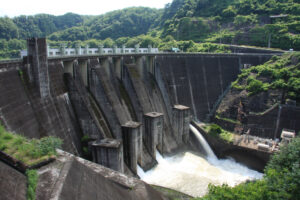
Takayama Dam
The dam was constructed in Minamiyamashiro Village in 1968 and began operation the following year. It’s 67 meters high, and stretches approximately 209 meters in length. It has six emergency gates that can be opened simultaneously to flush the water.
With abundant nature, this area is a good destination for driving and hiking. In the spring, you can see beautiful cherry blossoms. Around the middle of the dam’s reservoir, there is Tsukigase Baikei (Tsukigase Plum Valley) that is one of the “Places of Scenic Beauty” of Japan. It’s famous for its amazing plum blossoms. Uniquely, the reservoir spans across three prefectures: Kyoto, Nara, and Mie. Nearby, you can also find Tayama Tsurugi Tea Plantation. Recognized as a part of the Japan Heritage, it presents a culturally significant landscape.

投稿タイプ:sightseeing
Uji City Botanical Park
Uji City Botanical Park opened in October 1996. The spacious grounds, spanning approximately 10 hectares, feature a varied landscape with undulating terrain, a fountain, a pond, and streams that create beautiful scenery together with the plants.
The large-scale multi-level flower bed, Tapestry of Flowers and Water, is the largest in Japan, offering an impressive sight measuring 62 meters in width and 18 meters in height. 3,675 planters are arranged on the 46 tiers of the grand platform at the waterside, depicting characters and other themes related to Uji, seasonal motifs, and so on.
On the southwest (left) side of the park lies the Spring Zone, where cherry blossoms and various other flowers bloom. The weeping cherry blossoms are particularly popular, reaching full bloom around late March, and the nightly light-up (free of charge) is eagerly anticipated by many people every year. Visitors can enjoy the stunning view with the city nightscape.
In summer, fireflies can be seen around a stream. Additionally, the Summer Zone offers a display of lotus flowers, which once flourished on Ogura-ike Pond that once existed.
The northeast (right) side of the park boasts the Fall Zone, where visitors can admire beautiful fall foliage.
The greenhouse provides an environment to enjoy tropical and subtropical plants throughout the year, along with the waterfall.
投稿タイプ:sightseeing
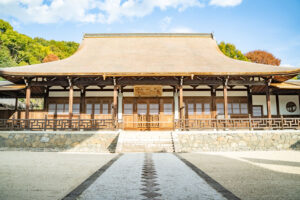
Manpuku-ji Temple
Obaku-san Manpuku-ji is the head temple of the Obaku sect of Zen Buddhism. In 2024, three of its buildings, including the main hall, were designated as National Treasures.
This temple was founded in 1661 by Ingen Ryuki (Yinyuan Longqi), a Chinese Zen Buddhist priest who came to Japan in 1654.
He introduced not only Zen Buddhism but also many things and cultural elements to Japan, such as ingen (common beans) and lotus roots.
One of them, Fucha Ryori (Chinese Buddhist cuisine), can actually be enjoyed at the temple (reservations required). It is characterized by its diverse offerings, with some artfully mimicking other foods, like one that resembles eel. It is fun to experience Chinese culture through food.
Also, the Chinese-style sutra chanting called Bonbai sounds like a song.
The precincts, with their historic buildings, are filled with a Chinese atmosphere. Other impressive sights include the Kaipan (wooden fish board), said to be the original form of mokugyo (a percussion instrument used to keep rhythm during sutra chanting), the golden statue of a deity Hotei Son (Budai), and the statue of Ragora Sonja (Rahula), from whose chest the face of Buddha emerges.
投稿タイプ:sightseeing
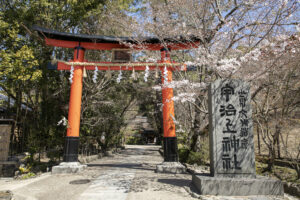
Ujikami Shrine
Ujikami Shrine is one of the World Heritage sites. It was once a single shrine together with Uji-Shrine, as a guardian shrine for Byodoin Temple.
The main hall (a National Treasure), built in the late Heian Period (794-1185), is the oldest existing shrine building in Japan. Built in the Nagare-zukuri style characterized by its long, flowing roof, it houses three structures to enshrine deities, which are two larger shrines flanking a smaller one in the center.
The worship hall (a National Treasure) is part of a building constructed in the Shinden-zukuri, the representative architectural style of aristocratic residences in the Heian Period.
The enshrined deities are Emperor Ojin, Uji no Wakiiratsuko, and Emperor Nintoku.
Ujikami Shrine offers charming rabbit omamori (Japanese amulets), omikuji (small items containing fortune-telling slips), and so on.
投稿タイプ:sightseeing
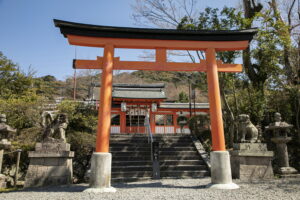
Uji-Shrine
Uji-Shrine was established in 313 on the right bank of the Uji River. The current main hall (an Important Cultural Property) was built in the Kamakura Period (1185-1333). Built in the architectural style called Sangensha Nagare-zukuri, it has a large roof and a facade with four pillars (creating three spaces). The shrine also preserves other various cultural properties, such as the oldest existing wooden komainu (a pair of guardian creatures called lion-dogs in colloquial English) and a valuable mask used in nō (a classical Japanese performing art).
The enshrined deity is Uji no Wakiiratsuko, believed to be a deity of academic achievement and success in entrance exams. This area was once home to Kirihara-Higeta-no-Miya, the detached palace of Emperor Ojin and the residence of his son, Uji no Wakiiratsuko.
Legend has it that when Uji no Wakiiratsuko lost his way, a rabbit appeared and guided him, looking back repeatedly to ensure he was following. According to one theory, this is the origin of the place name Uji (rabbit path). At Uji-Shrine, Mikaeri Usagi (looking-back rabbit), a messenger of a deity, guiding people to the right direction, is worshipped. There is a temizuya (place to purify hands with water) with a rabbit motif, cute rabbit omikuji (small items containing fortune-telling slips) and ema (small plaques to write wishes), and so on.
投稿タイプ:sightseeing
Omido Kannonji Temple
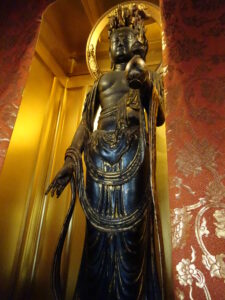
Omido Kannonji Temple is located in Kyotanabe City in the Kyoto Tea Country region. The temple is believed to have been founded over 1,300 years ago at the request of Emperor Tenmu. It has suffered from numerous fires throughout its history, and most of its 13 halls and more than 20 living quarters of monks were lost in the fire in 1437. Only the Omido (the main hall) was rebuilt later, and it survives to this day. (It was last rebuilt in 1953.)
The temple is dedicated to Kannon (Avalokiteśvara) Bodhisattva. The statue of Eleven-Headed Kannon Bodhisattva is created with sophisticated techniques by layering using lacquer repeatedly, and the surface is finished with gold leaves. It is one of seven statues of Eleven-Headed Kannon Bodhisattva designated as National Treasures.
In spring, yellow carpets of rapeseed blossoms spread out in front of the temple, which is a spectacular sight. You can also see beautiful cherry blossoms on the approach to the temple.
In autumn, the main hall and garden are beautiful with fall foliage. A nighttime illumination event is held every year, in which visitors can enjoy the fall colors with the traditional Japanese ambiance.
投稿タイプ:sightseeing
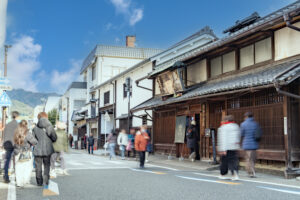
Ujibashi Street
Ujibashi Street is one of the main streets leading from JR Uji Station to Byodoin Temple. This street preserves old buildings including long-established shops of tea farmers and tea manufacturers. The street also boasts a vibrant mix of restaurants, cafes, bakeries, sweet shops, a supermarket, and many more. Not just tourists, but locals also enjoy shopping and dining here. The street leads to Uji River, and before Uji-bashi Bridge is a popular photo spot with a statue of Murasaki Shikibu, the author of The Tale of Genji.
投稿タイプ:sightseeing
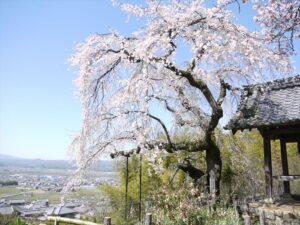
Jizozen-in Temple
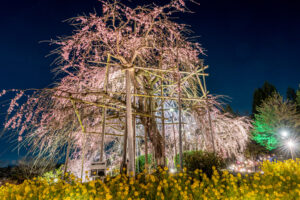
Located at an elevation of over 100 meters and to the southwest of Tamatsuoka Shrine, Jizozen-in Temple offers a sweeping view over the plain of Ide Town. There is a weeping cherry tree with clouds of blossoms that is designated as a Natural Monument of Kyoto Prefecture. The tree is estimated to be approximately 300 years old. The tree is related to a very famous hanami (cherry-blossom viewing) spot in Kyoto City, Maruyama Park. The park’s first-generation weeping cherry tree and this old tree have the same mother tree, actually. In Ide, this weeping cherry tree stands on a stone wall, and there is a hanging bell behind it. It has a classic Japanese charm, and when the sun sets, the view is breathtaking!
投稿タイプ:sightseeing
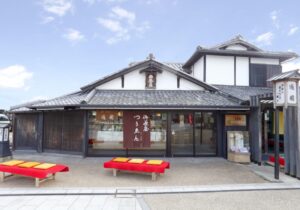
Tsuen-chaya Teahouse
Uji-bashi Bridge has been a vital point in Uji throughout its long history. This long-established teahouse, located on the east bank of the river, was built in 1160. It has served as not only a teahouse, but also a guardian of the bridge, wishing for the safety of travelers passing by. It is the oldest existing teahouse in Japan.
The current building was constructed in 1672, showcasing the architectural style of machiya (traditional townhouses) in the Edo Period (around 1603-1868). It is registered as a part of the Japan Heritage (Japanese Tea: Eight Centuries of Tradition).
Inside the teahouse, you can find chatsubo (traditional tea jars) made centuries ago, the wooden statue of the first-generation Tsuen created and presented by Ikkyu Sojun enshrined within, and a wooden bucket that is said to have been made by Sen no Rikyu and used by Toyotomi Hideyoshi to draw the clear water of the Uji River. Renowned historical figures, including Ashikaga Yoshimasa, Toyotomi Hideyoshi, and Tokugawa Ieyasu, have visited this teahouse.
At the storefront, you can purchase matcha (powdered green tea), sencha (one of the most common Japanese teas), hojicha (roasted tea), and more. Inside, you can enjoy matcha sweets like parfaits and zenzai (dessert soup made with red beans) made with plenty of freshly ground matcha, a combo of matcha and cha-dango (skewered rice dumplings made with matcha), cha-soba (buckwheat noodles made with matcha) and so on, while gazing out at the Uji-bashi Bridge and Uji River.
投稿タイプ:sightseeing
Keihanna Commemorative Park
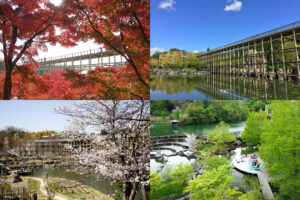
The Keihanna Commemorative Park, officially called the Kyoto Prefectural Kansai Culture and Science City Commemorative Park, is 24.1 hectares in size. It was built to commemorate the establishment of the Keihanna Science City (officially known as the Kansai Science City), and opened to the public in 1995. It has a free area and a paid area. The free area includes Hiroba (Open Space), which has a large, stepped lawn area resembling a tanada (rice terrace), where people can relax and children can run and play freely. There is also a free playground for kids. In the Taniai (Valley) area, you can view a typical Japanese landscape with a small stream, a bamboo grove, and a plum garden. In the paid area, there is Suikei-en, a Japanese-style garden with paths that bring you to fascinating spots including a cascading pond, a magnificent Rock Cluster, beautiful places with seasonal flowers, and Floating Stage where you can feed Japanese carp. It’s enjoyable for children and adults alike. Kangetsukyo Bridge is eye-catching. It’s 123 meters long, 4 meters wide, and approximately 10 meters tall above the water. From the bridge, you can enjoy the panoramic view of the large garden. Particularly spectacular is the fall foliage of the Maple Valley. Among the moss, approximately 140 Japanese maple trees line a small, delicate stream. Suikei-en is a wonderful place where you can view both satoyama (cultivated countryside) landscapes, and the large and beautiful bridge. Also, at Mebuki-no-Mori (Budding Tree Forest), you can enjoy strolling through abundant nature, which offers different scenery depending on the season. Additionally, you can enjoy a range of events, from firefly-viewing and star-gazing to traditional Japanese events.
投稿タイプ:sightseeing
Amagase Dam
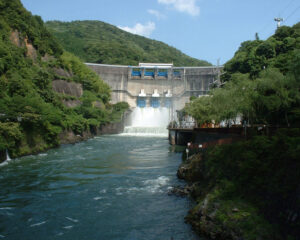
This multipurpose dam was constructed in 1964 to prevent floods, generate electricity, and supply drinking water. The majestic Amagaze Dam, standing at a height of 73 meters and a length of 254 meters, is a dome-shaped arch dam. If you're lucky, you might see the spectacular sight of the dam releasing water.
One of the dam’s charms is its location. It’s close to the city center of Uji, making it a relatively convenient stop for those sightseeing or going on a cycling trip. Downstream from the dam, there are World Heritage sites, Byodoin Temple and Ujikami Shrine.
From the dam, you can see the reservoir called Lake Houou (Lake Phoenix). Its shape resembles a bird spreading its wings, and the name represents people's hope to create a paradise on earth. You can enjoy the amazing view of the lake with the seasonal beauty of nature around it.
投稿タイプ:sightseeing
Joruriji Temple
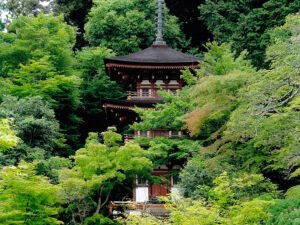
Joruriji Temple, located in the southern part of the Kyoto Tea Country region, is a temple of the Shingon Risshu sect of Buddhism. Though the early history of the temple is shrouded in mystery, historical records of the temple state that the monk Gimei enshrined Yakushi Nyorai (the Medicine Buddha) in the first main hall in 1047. Yakushi Nyorai is the master of Eastern Pure Land Buddhism, and is officially called “Yakushi Ruriko Nyorai,” which is the origin of the temple's name.
The temple houses National Treasures (the Main Hall, the Three-Storied Pagoda, nine statues of Amida Nyorai, and statues of the Four Heavenly Kings) and several Important Cultural Properties, including the statue of Yakushi Nyorai.
In the main hall, the nine Amida Nyorai statues are lined up in a long row, which is quite splendid. It is said that approximately 30 halls like this were built around Kyoto in the Heian Period (794-1185), but this is the only one that still exists in a perfect form.
The temple’s garden depicts Gokuraku Jodo (the Pure Land in Buddhism). To the east of the main hall is a garden with a serene pond, and beyond the pond, there stands the Three-Storied Pagoda with the Yakushi Nyorai statue enshrined in it. The pond is said to be in the shape of the Sanskrit letter (the Siddham script) "a." The garden has remained in its original state, making it a rare and precious place. Surrounded by abundant nature, it is designated as the Place of Scenic Beauty in Japan.
You can enjoy beautiful scenery throughout the year. Moreover, paths connecting Joruriji Temple and Gansenji Temple called Sekibutsu no Michi (paths with stone Buddhas) are a great place for hiking through history where you can meet many stone Buddhas.