Term archive
投稿タイプ:sightseeing
The Inaba Merchant’s House
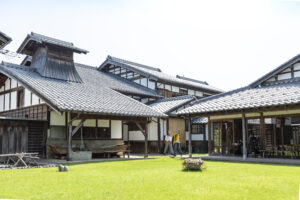
The Inaba family are decendents of a subordinate of 14th century warlord Oda Nobunaga. They became rich by selling malted rice, and did shipping commerce along the coast. In 1735 they were in charge of the shogunate funds of the Kumihama area (similar to the central bank today), and became the top merchants in the area. The merchant family's rich life is exhibited here, and the building itself is registered as a Tangible Cultural Property of Japan. Inside there are pieces of pottery, incense, and china-painting workshops, as well as a restaurant for barazushi (a type of sushi with ingredients spread on rice) and botamochi cakes.

投稿タイプ:sightseeing
Maizuru Repatriation Memorial Museum
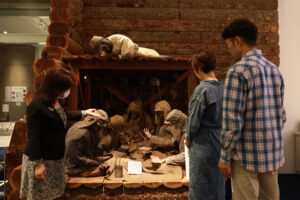
After the end of the Second World War, the Port of Maizuru was designated by the government as one of several ports through which repatriates could enter their homeland. Over 13 years it has received repatriates from old Manchuria, Korea, and Siberia, the majority of whom (around 600,000) were kept in forced-labour camps in Siberia. The Maizuru Repatriation Memorial Museum tells the story of this period, shows the warm welcome of the Maizuru people towards the returning soldiers, and proclaims the value of peace to the world. Clothes from the labour camps are exhibited, as well as letters and diaries written by soldiers to their families. In 2015, 570 items, including the famous Shirakaba Diary (a diary written on the bark of Siberian silver birch), were inscribed on the UNESCO Memory of the World Register.
投稿タイプ:sightseeing
Yoshiwara
The Yoshiwara area of Maizuru City is about 1.7 kilometers from the nearest railway station, JR Nishimaizuru Station.
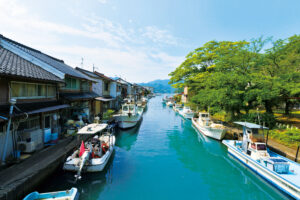
During the Edo period, the fishing town was moved from Nishimaizuru to its current location. Boasting a history of 300 years, the town’s narrow roads are positioned like tessellated pavement, and there are canals for the coming and going boats. Despite the long period of time since they were built, the old houses still stand, allowing us to see a sight uncommon in normal fishing towns. The houses are long and narrow, built side by side with hardly any space in between, while the back door connects to the canal, allowing boats to sail directly from the houses. There are about 100 of these houses, which are not unlike the boathouses in Ine, and they can be seen all over the town.
Often dubbed Asia’s Venice, walking through Yoshiwara is like traveling in time back to the 1930s, where you can enjoy the quaint fishing town’s laid-back atmosphere.
投稿タイプ:sightseeing
Tateiwa (Standing) Rock
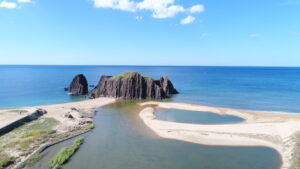
Tateiwa (pronounced Tateh-Ihwa) Rock is a part of Japan's San'in Coast Geopark. It is located on Nochigahama Beach in Kyotango City, Kyoto Prefecture. Standing at 20 meters tall, it is one of Japan's largest monoliths and is made from a type of volcanic rock called andesite.
According to legend, when Prince Maroko (the half-brother of the legendary Prince Shotoku) killed an oni (a demon in Japanese folklore) on this spot, the oni became trapped in the enormous rock overnight. It's said that even now, on nights when the winds are strong and waves are high, you can still hear the cries of the oni trapped within.
Tateiwa got its name from the way it stands tall (tate = stand/vertical, iwa = rock), and creates beautiful scenery with the way it stands out of the Sea of Japan.
投稿タイプ:sightseeing
Sodeshi Rice Terraces
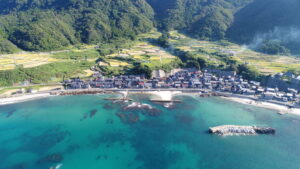
Sodeshi Village of Tango-cho, Kyotango City, is located on the northernmost peninsula in the Kinki area. It is famous for rice terraces that stretch out between the steep mountainside and the ocean. The land was originally a flat and shallow seabed that was raised by an earthquake, and gradually shaped through erosion by the waves, creating approximately 400 rice terraces.
From these rice terraces you can see the Sea of Japan. The harmony between this village and the sea has created some incredibly beautiful scenery, certified as "One of the best 100 rice terraces in Japan". At the beginning of May the rice sprouts are planted and the terraces are filled with water. Then, at the beginning of September, the rice is harvested. Both make for beautiful scenes to enjoy.
*Note, because these rice terraces are in use, be careful not to get in the way of traffic.
投稿タイプ:sightseeing
Maizuru Red Brick Park
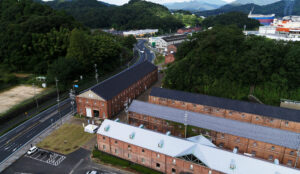
The red brick warehouses of Maizuru Red Brick Park in Kitasui District, Maizuru City, when used as storehouses for the pre-war Maizuru Naval District, and were built one after another between 1900 and 1921. In order to make use of these red brick buildings, the city of Maizuru opened them as tourist attractions in 2012 as "Maizuru Red Brick Park."
The seven red brick warehouses here have been rennovated, and are designated as Important Cultural Properties. Buildings 2 and 3 contain a café and exhibition space, and buildings 4 and 5 are used for live events, art festivals, and more.
投稿タイプ:sightseeing
Mt. Kabutoyama Observatory Deck
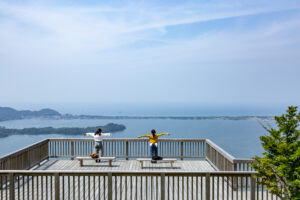
Mt. Kabutoyama s a 191.7 m tall mountain that overlooks Kumihama Bay. The rounded shape of the mountain resembles the shape of a samurai helmet (Kabuto), which is how Kabutoyama got its name (yama means mountain). Mt. Kabutoyama Observatory Deck at the top of the mountain takes approximately 20 minutes to reach on foot via a well-maintained trail starting at the foot of the mountain. The wooden observatory deck faces out towards Kumihama Bay where the unique mountainous topography has formed a thin sand bar called Shotenkyo, which encircles the bay and separates the calm waters of the bay from the Sea of Japan. The sweeping view of the contrasting green rice paddies against the blue sea is a spectaulor sight. "Shotenkyo" translates to "small heavenly bridge," and is said to be named after one of Japan's most famous scenic views, Amanohashidate, the large sandbar that represents a bridge to the heavens in Japanese mythology.
投稿タイプ:sightseeing
Obara-jinja Shrine
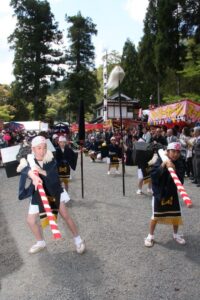
Designated as a cultural property in Kyoto Prefecture, the deities enshrined at Obara-jinja Shrine have long been known to grant safe delivery and good harvest, as well as of traffic safety, more recently. The shrine is popular among many visitors. Near the shrine, there is a delivery room designated as a prefectural Tangible Folk Cultural Property.
In autumn, the precincts are painted with fall colors.
投稿タイプ:sightseeing
Nariai-ji Temple
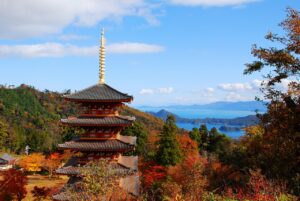
Nariai-ji Temple is located on a mountainside overlooking Amanohashidate” which is considered one of the three most scenic spots in Japan. There is an endless line of visitors to the temple, as it is the 28th temple of the Saigoku Kannon Pilgrimage.
Autumn leaves around the five-story pagoda turn a spectacular red in autumn, and the scenery here looks just like a picture scroll. A light-up event will be held on November 10th and 11th.
投稿タイプ:sightseeing
Fringed Iris & Oriental Paperbush Meadow
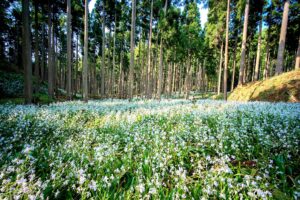
Oitomi is a town in Ayabe City in the north of Kyoto Prefecture, where there's a forest with dense fields of oriental paperbush (mitsumata) and fringed iris (shaga, Iris Japonica) flowers. These fields were discovered in 2015 by a photographer, and are a rare and beautiful sight. From the end of March to mid-April a sea of oriental paperbush flowers bloom and cover about 1.5 hectares of land. Oriental paperbush is a deciduous shrub that grows 1-2 meters tall, with little scented yellow flowers which are made up of four sepals with no petals, and a fibrous bark that has historically been used as material for washi (Japanese paper) and paper money. From the end of April until mid-May, after the oriental paperbush season, the mysterious-looking, snow white fringed iris bloom and cover the forest floor. In some parts of the forest, there's also a 400 meter-long "corridor of irises." The flowers are short-lived and last just a single day, but every day new flowers bloom to replace them. During the flowering season from the end of March to mid-May, you can also find local goods, tea, coffee, and sweet red bean-based soup at the Hanayadori rest area, which is open on Wednesdays, Fridays, Saturdays, Sundays, and holidays from 10:00 a.m. to 3:00 p.m.. While you don't need to hike to see the flowers, the forest is not paved please make your visit in shoes you don't mind dirtying.

投稿タイプ:sightseeing
Omoto Headquarters (Ayabe/Baishoen)
Oomoto Baisho-en is located along the banks of the Yura River that runs through Ayabe City in the Woodland Kyoto. It is the home of the religious organization “Omoto Baisho-en” and was opened in 1892. The institute was founded by an ordinary couple and is dedicated to bringing the religions of the world together in peace. The Organization plays hosts to spring and autumn festivals as well as a grand Setsubun festival.
The grounds contain many great halls including; “Choseiden” hall the largest wooden structure built in the 20th Century, “Mirokuden” hall which is a registered tangible cultural property, and “Konohanaan,” a traditional home that is designated as a national important cultural property and is believed to be the oldest building in the Tamba region. If you get the chance to go inside these beautiful halls, you will see space dedicated the practice of many different arts such as aikido, traditional noh theater, and tea ceremony, as they believe art is an essential part of spirituality.
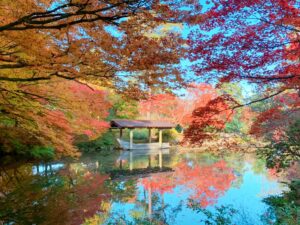
The garden surrounding the temples is called “Kinryukai” and filled with maple trees that turn the entire garden a shade of red in the fall making Omoto Baisho-en one of the most famous spots for sightseeing in Ayabe. The garden is designed to be a microcosm of the world with ponds and islands layed out to imitate the main five continents. In addition, there is a single large cherry tree called "Konohana Sakura" next to the "Choseiden" hall which blooms around mid April every year.
投稿タイプ:sightseeing
Yakuno Highland
The Yakuno Highland, located in Yakuno-cho, Fukuchiyama City in the northwest of Kyoto Prefecture, is a highland area created by a volcanic eruption of the prefecture's sole volcano, Mt. Takura (Mt. Takara).
The Yakuno district is located on the border with Hyogo Prefecture, surrounded by nature and mountains of some 700 meters in height.
In spring, many people come to see the weeping cherry trees at the Kyoto Prefectural Tree Planting Center, commonly known as the "weeping cherry of Yakuno-cho."
Once the cherry blossom season has ended, Shirai Omachi Wisteria Park in neighboring Asaku City, Hyogo Prefecture sees a bloom of wisteria the greatest of its size in the mountains here. In summer, the Yakuno area becomes a retreat from the heat, and in autumn the leaves are a colorful sight. With its beautiful natual scenery throughout the four seasons, the Yakuno area is visited by many throughout the year.
At Nosho-no-sato Yakuno Roadside Station in particular, visitors can enjoy some of the best of Woodland Kyoto with its hot springs, overnight accommodation, activities, dining, and shopping.